Gagged in the Ward: The NHS Culture of Silence That Is Killing Patients and Protecting Managers

Photo of Wes Streeting, via Wikimedia Commons
The Price of Speaking Out
In the spring of 2023, a senior nurse at an NHS acute trust in the Midlands raised formal concerns about staffing levels on a high-dependency ward. She documented her concerns in writing, escalated them through the trust's internal Freedom to Speak Up process, and waited. Within eight weeks, she had been redeployed to an administrative role, placed under a performance improvement plan, and presented with a settlement agreement that included a non-disclosure clause. She signed it. She had a mortgage and two children. She has not worked in clinical nursing since.
Her case is not exceptional. It is, according to employment tribunal records, the Care Quality Commission's own inspection reports, and the evidence gathered by successive parliamentary inquiries, depressingly routine. The NHS has a whistleblower problem — not because individual managers are uniquely malevolent, but because the system has been constructed, layer by institutional layer, to prioritise reputation management over patient safety. And the consequences, measured in preventable deaths and delayed diagnoses, are catastrophic.
A System Built to Protect Itself
The architecture of NHS whistleblower suppression is not accidental. It has evolved over decades, shaped by the incentives that govern NHS management. Trust chief executives are appointed by boards, evaluated on financial performance and inspection ratings, and rewarded with salaries that now routinely exceed £200,000. A scandal — a coroner's report, a CQC inadequate rating, a national media investigation — is an existential threat to a career. A nurse who raises concerns is, from that perspective, not a safeguard but a liability.
The tools available to silence her are extensive. Non-disclosure agreements — NDAs — are routinely included in settlement packages offered to departing NHS staff. The government announced in 2019 that NDAs would be prohibited in cases involving patient safety concerns. That prohibition has not been consistently enforced. A 2022 report by the charity Protect, which supports whistleblowers, found that NDAs referencing patient safety were still being used across multiple NHS trusts, often presented to staff under conditions of considerable financial and psychological pressure.
Beyond NDAs, the Freedom to Speak Up Guardian system — introduced following the Francis Inquiry into the Mid Staffordshire scandal — was designed to give clinical staff a protected channel for raising concerns. In practice, Freedom to Speak Up Guardians are employed by the trusts they are supposed to hold to account. They have no independent investigative powers, no authority to compel disclosure, and no protection from the institutional pressures that govern everyone else in the building. The Francis Inquiry itself found that at Mid Stafford, concerns had been raised repeatedly, by multiple members of staff, and systematically ignored. The response to that finding was to create a new layer of bureaucracy within the same institutional structure that produced the problem.
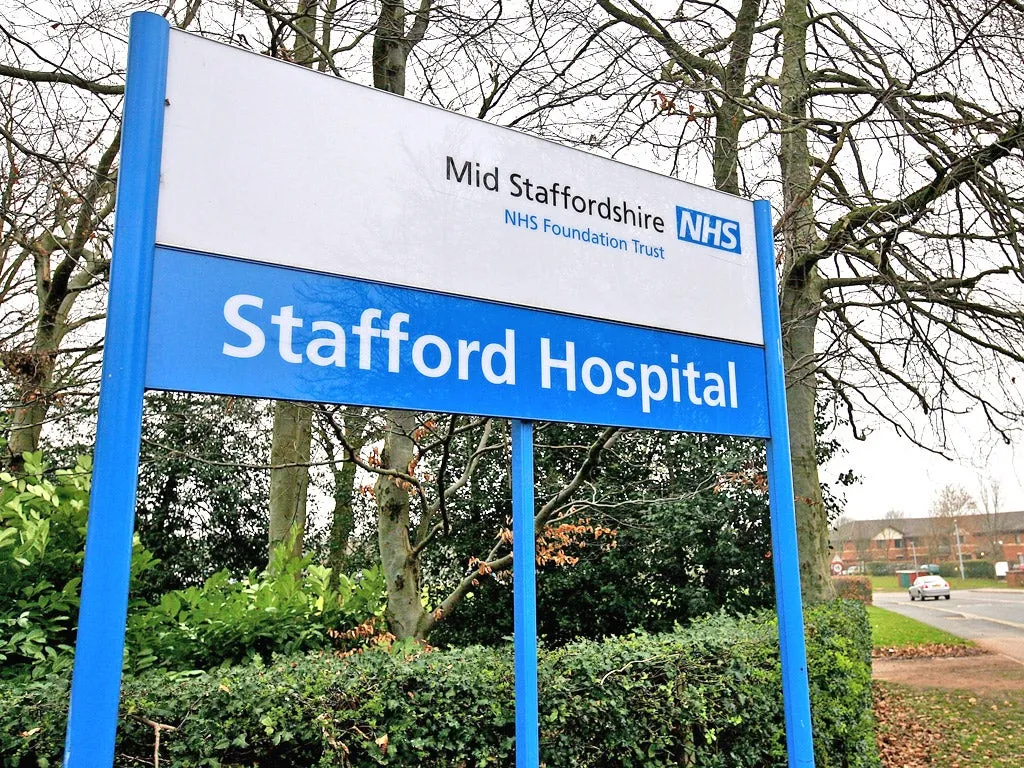 Photo: Mid Staffordshire, via static.independent.co.uk
The Union Dimension
Any honest account of the NHS's culture of silence must address the role of the major healthcare unions. Unison and the Royal College of Nursing represent the majority of clinical staff and wield considerable influence over trust management. In principle, they are champions of their members' rights, including the right to raise patient safety concerns without retaliation. In practice, the relationship between union structures and NHS management is considerably more complex.
Unions negotiate nationally with NHS England and locally with trust management. They have an institutional interest in stable industrial relations. A whistleblower who takes on trust management disrupts that stability. Employment tribunal records contain multiple cases in which union representatives advised members to accept settlement agreements — complete with NDAs — rather than pursue public interest disclosures. This is not universal, and there are union officials who have supported whistleblowers courageously. But the structural incentive runs in the other direction, and the evidence reflects it.
The Public Interest Disclosure Act 1998 — the statutory framework protecting whistleblowers — provides legal recourse through employment tribunals. But tribunal proceedings are slow, expensive, and emotionally devastating. The average time from claim to hearing has extended significantly in recent years. Legal aid for employment cases is severely restricted. The practical reality is that most NHS staff who face retaliation for raising concerns cannot afford to fight. The settlement agreement, with its NDA, is the path of least resistance. The institution knows this. It relies on it.
What the Inspectors Found — and What Happened Next
The Care Quality Commission publishes inspection reports that occasionally pierce the veil of institutional self-presentation. Reports from trusts rated 'requires improvement' or 'inadequate' frequently contain findings about staff who did not feel safe raising concerns, about cultures of blame, and about management responses to complaints that prioritised process over substance. These findings are noted, recommendations are made, and the trust is re-inspected. Sometimes ratings improve. Sometimes they do not. The underlying culture — the one that determines whether a junior doctor feels safe raising an alarm at three in the morning — is not something a scheduled inspection can reliably detect or transform.
The case of East Kent Hospitals University NHS Foundation Trust is instructive. The independent investigation led by Dr Bill Kirkup, published in 2023, found that preventable deaths in the maternity unit had occurred over a sustained period, that concerns had been raised and ignored, and that a culture of 'them and us' between management and clinical staff had contributed directly to patient harm. East Kent is not an outlier. It is a case study in what happens when institutional self-protection is permitted to operate without effective external accountability.
 Photo: Dr Bill Kirkup, via i2-prod.mirror.co.uk
 Photo: East Kent Hospitals University NHS Foundation Trust, via c8.alamy.com
The Reform That Is Never Proposed
After every scandal, the response follows a predictable pattern. An inquiry is commissioned. A report is published. Recommendations are made. A new process is introduced. The culture does not change, because the incentive structure does not change. The management class that presided over the failure is rarely held personally accountable. Individuals are moved sideways. Trusts are merged. The bureaucracy absorbs the criticism and continues.
Genuine reform would require something the political class has consistently refused to contemplate: breaking the closed institutional loop. That means independent whistleblower protection bodies with statutory investigative powers, operating entirely outside NHS management structures. It means enforceable personal liability for executives who are found to have suppressed patient safety concerns. It means reforming the settlement agreement process so that NDAs covering clinical matters are void as a matter of law, not merely discouraged as a matter of guidance. And it means confronting, honestly, the role that union structures and management incentives play in perpetuating a culture that protects careers at the expense of patients.
More money will not fix this. The NHS budget has increased in real terms in almost every year of the past two decades. The culture of silence has persisted regardless. What is needed is not resources but accountability — the kind that actually costs someone something when they get it wrong.
Until NHS managers face genuine personal consequences for silencing the staff who try to prevent patient harm, every inquiry, every review, and every Freedom to Speak Up Guardian is nothing more than an elaborate performance of concern — and patients will continue to pay the price.