The English Question: Why the Barnett Formula Is a Constitutional Injustice That Can No Longer Be Ignored
The Arithmetic of Asymmetry
Let us begin with the numbers, because the numbers are stark. According to HM Treasury's own public expenditure statistical analyses, identifiable public spending per head in Scotland consistently runs at approximately 25 per cent above the English average. In the most recent available data, that translates to roughly £14,000 per person per year in Scotland against approximately £11,500 in England. The gap is not marginal. It is structural, it is deliberate, and it is funded in substantial part by English taxpayers who receive no corresponding benefit and exercise no democratic influence over how the money is spent.
The mechanism is the Barnett Formula, a 1970s administrative convenience devised by Joel Barnett — who subsequently described it as a short-term fix that had long outlived its usefulness — and which has calcified into a near-untouchable feature of the British constitutional settlement. Under Barnett, changes in spending on devolved services in England automatically generate a population-proportionate adjustment in the block grants paid to Scotland, Wales, and Northern Ireland. The formula does not reflect need, deprivation, or any principled assessment of what public services actually cost to deliver in different parts of the country. It reflects history, political expediency, and the accumulated lobbying power of devolved administrations with every incentive to defend their preferential position.
 Photo: Joel Barnett, via disruptivehr.com
What That Money Buys — and Who Pays for It
The practical consequences of this spending differential are visible and tangible. Scottish students pay no tuition fees for university education. English students pay up to £9,250 per year. Scottish residents receive free personal care in old age. English residents face a means-tested system that can consume life savings. Prescriptions in Scotland are free at the point of dispensing. In England, they cost £9.90 per item. These are not trivial differences. They represent significant transfers of welfare that are funded, in part, by English taxpayers who are simultaneously denied access to them.
The standard response from defenders of the status quo is that Scotland raises its own taxes and makes its own spending decisions. This is partially true — the Scotland Act 2016 extended Holyrood's tax-varying powers considerably — but it does not account for the base-level block grant, which remains substantially above what a needs-based formula would generate. The Fraser of Allander Institute, a respected Scottish economics research body, has acknowledged that Scotland benefits from a fiscal transfer from the rest of the United Kingdom that would not survive a strictly needs-based assessment. The Scottish Government's own figures have consistently shown a notional fiscal deficit — the gap between tax raised in Scotland and public spending there — that runs to tens of billions of pounds annually.
To put it plainly: Scotland is a net beneficiary of the union in fiscal terms, and England is the primary net contributor. That is not an argument against the union. It may be a perfectly reasonable expression of solidarity between constituent nations. But it is an arrangement that deserves honest acknowledgement, open democratic debate, and — crucially — some form of English voice in how the overall settlement is calibrated.
The West Lothian Question, Still Unanswered
The constitutional anomaly that compounds the fiscal one is the West Lothian Question, first articulated by the late Tam Dalyell in 1977 and still, nearly half a century later, without a satisfactory resolution. Scottish MPs sitting at Westminster vote on legislation that affects only England — on English health policy, English education, English planning law — while English MPs have no reciprocal right to vote on the same matters as they apply in Scotland, which are decided at Holyrood. The asymmetry is not subtle. It is a straightforward democratic deficit, and it has been managed rather than resolved by every government since devolution.
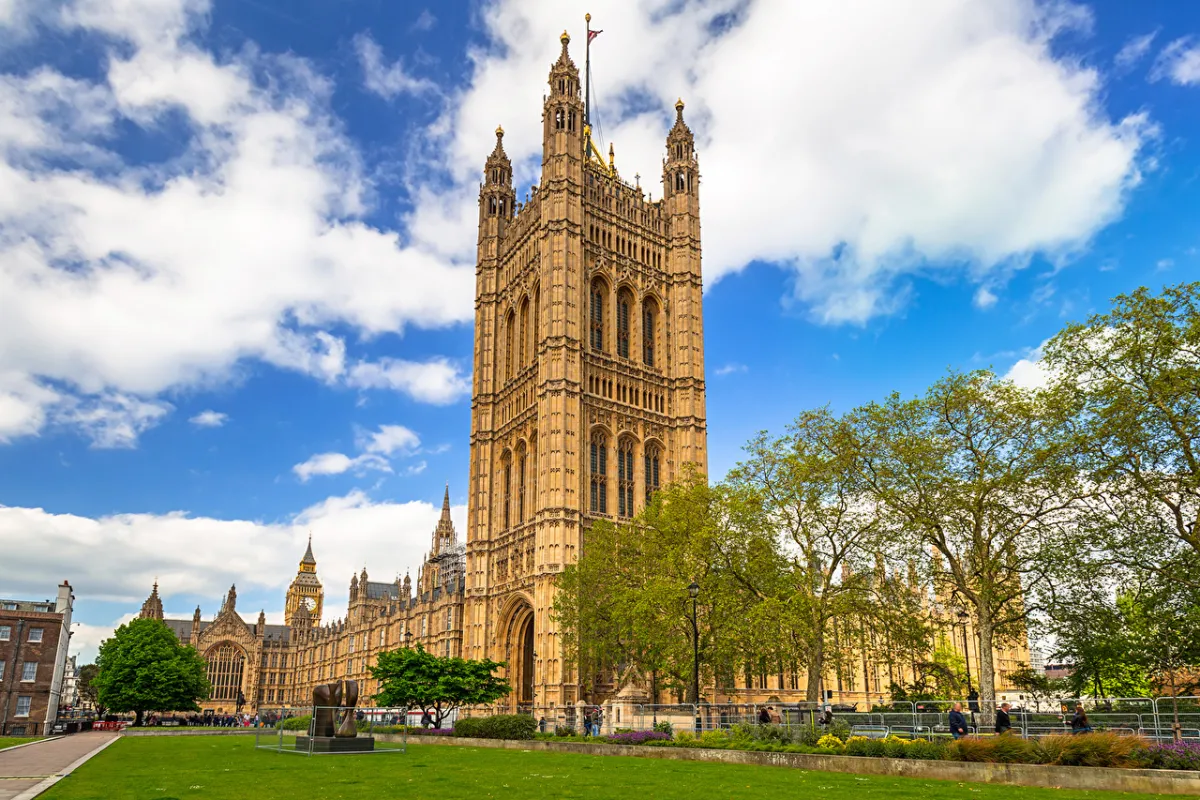 Photo: Palace of Westminster, via 3.bp.blogspot.com
 Photo: Tam Dalyell, via cdn.images.express.co.uk
The coalition government introduced English Votes for English Laws — EVEL — in 2015, a procedural mechanism that gave English MPs a veto on England-only legislation. It was a modest step in the right direction, and it was abolished by the House of Commons in 2021 with almost no public debate. The official justification was that it complicated parliamentary procedure. The real reason, one suspects, is that it was inconvenient for a Labour Party that relies heavily on Scottish and Welsh seats to pass its domestic agenda.
There is no English Parliament. There is no First Minister for England. There is no institution through which the 56 million people of England can express a collective democratic will on matters that affect them alone. The devolution settlement created powerful institutions for Scotland, Wales, and Northern Ireland while leaving England — the largest nation in the union, home to 84 per cent of its population — governed entirely from a Parliament in which it shares representation with nations that have their own separate legislatures for domestic matters. This is not a minor administrative quirk. It is a constitutional anomaly of the first order.
This Is Not English Nationalism. It Is Basic Democratic Fairness.
The political class has become adept at deflecting any serious discussion of English interests by characterising it as nationalism — as though demanding equal treatment under a shared constitutional settlement were somehow equivalent to separatism. It is not. The demand for fiscal fairness and democratic accountability for England is not a demand to break up the United Kingdom. It is a demand that the United Kingdom be organised on principles that are defensible to all its constituent peoples, not merely those whose devolved institutions have given them leverage to extract preferential treatment.
Labour has historically been the most resistant to English devolution, for the straightforward reason that an English Parliament with meaningful powers would be a Conservative-dominated institution for the foreseeable future. The SNP, meanwhile, benefits from the current arrangement in two ways: the fiscal transfer subsidises the policy platform that sustains their electoral support, while the constitutional grievances generated by Westminister's handling of devolution fuel the separatist case. Both parties, for entirely different reasons, are content to leave the English Question unanswered.
The Political Resentment Is Growing
What neither party should underestimate is the rate at which English patience with this arrangement is eroding. Polling by the think tank Policy Exchange has found growing support among English voters for an English Parliament, for reform of the Barnett Formula, and for the principle that Scottish MPs should not vote on English-only legislation. The sentiment is not yet a dominant political force, but it is moving in one direction. As the cost of living bites, as NHS waiting lists lengthen, and as English voters watch Scottish residents receive services they cannot access themselves, the question of why they are subsidising a settlement that excludes them will become increasingly difficult to avoid.
A genuinely conservative constitutional vision — one rooted in democratic accountability, fiscal responsibility, and the equal dignity of citizens regardless of where in the country they live — demands engagement with the English Question. Not as an act of nationalist grievance, but as a straightforward exercise in constitutional principle. The Barnett Formula is indefensible on any objective measure of fairness. The West Lothian Question is a standing democratic injustice. And the absence of any English institution capable of articulating English interests is a gap in the constitutional settlement that will, eventually, demand to be filled.
Fiscal fairness and democratic accountability are not English nationalism — they are the foundations of any union that intends to last.