Powering Down Britain: The Quiet Industrial Suicide of Our Net Zero Targets
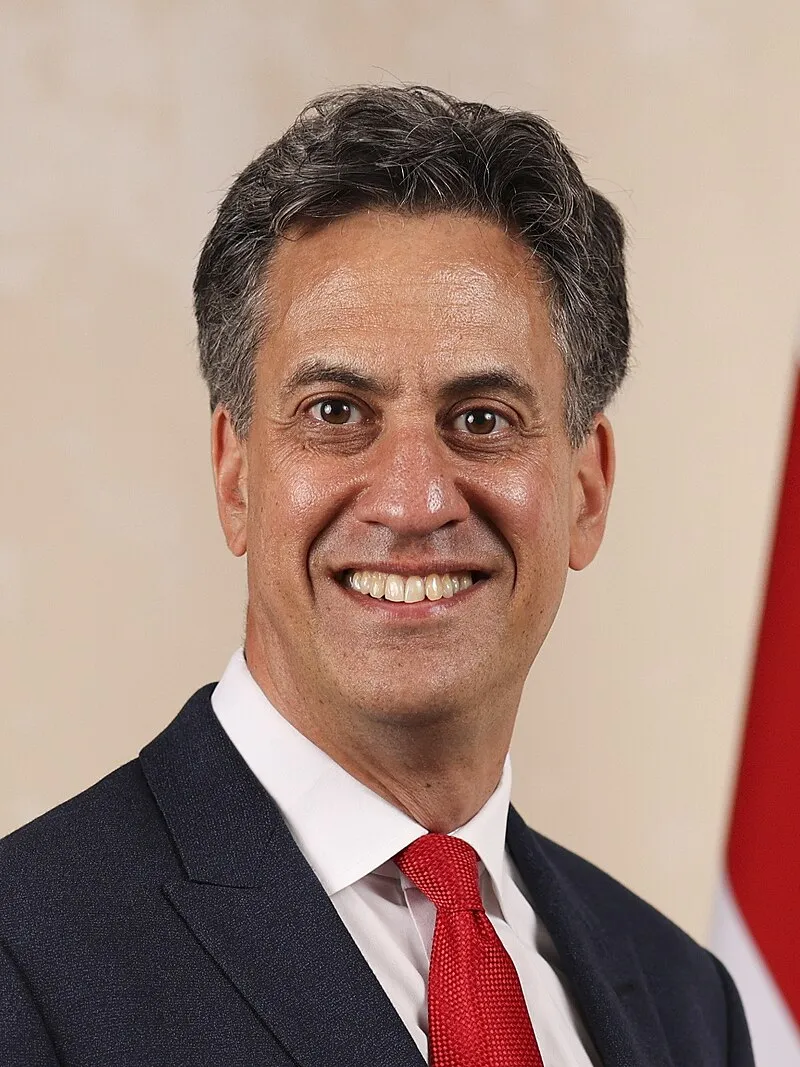
Photo of Ed Miliband, via Wikimedia Commons
The Climate Change Act 2008 made the United Kingdom the first country in the world to write binding emissions targets into law, and successive governments — Conservative ones included — have competed to raise the ambition: a 68 per cent cut by 2030, net zero by 2050, and a ban on new petrol and diesel cars from 2030. Meanwhile, the economic cost of this unilateral enthusiasm is no longer a modelling exercise. It is visible in the closure of oil refineries on Humberside, in the loss of the last primary steelmaking at Port Talbot, and in household electricity prices that rank among the highest in the developed world.
The Price of Going First
According to figures from the International Energy Agency and industry bodies such as EUA and Energy UK, British industrial electricity prices have for years been among the steepest in Europe — frequently double or triple those faced by manufacturers in the United States, and well above those in France and Germany once support schemes are netted off. The chemicals sector, energy-intensive and globally traded, has been shrinking steadily; INEOS has repeatedly warned that its Grangemouth operations were uncompetitive partly because of UK energy costs. CF Fertilisers closed its Billingham ammonia plant in 2023, ending domestic production of a chemical that underpins the food chain.
This is carbon leakage by another name: production does not vanish, it relocates to jurisdictions with cheaper energy and weaker environmental rules. Britain imports the steel, the chemicals and the cement, emits the same global tonnage elsewhere, and congratulates itself on the domestic accounting. It is a policy that flatters our statistics while impoverishing our workforce.
Who Actually Pays
The costs are stacked, quietly, on ordinary bills. Environmental and social obligations — the carbon price support levy, the Renewables Obligation legacy costs, Contracts for Difference subsidies, the Emissions Trading Scheme — are recovered through electricity and gas charges. Ofgem's own breakdowns show policy costs forming a meaningful slice of the typical dual-fuel bill, a slice that rises as the grid buildout accelerates. Regressive by design, these levies fall hardest on pensioners and low-income households who cannot afford a heat pump or an electric car but must still pay for the transition in other people's homes.
The strongest counter-argument deserves a fair hearing. Wholesale gas prices, not green levies, drove the energy crisis of 2022; the fastest protection from volatile global gas markets is domestic renewable generation, which has no fuel cost. This is true — but incomplete. Renewables still require firm backup for windless weeks, grid reinforcement on a scale that will cost tens of billions, and the balancing costs that now routinely make National Grid pay wind farms to switch off while gas plants run to keep the lights on. The system costs are real, and the government's own advisers at the Climate Change Committee acknowledge that the transition requires sustained investment that someone, eventually, must fund.
The National Interest Test
Environmental policy should be judged by three tests: does it keep the lights on, does it keep bills affordable, and does it strengthen or weaken Britain's position relative to competitors? On all three, the current settlement is failing. Energy security was once a cross-party consensus; it has been subordinated to diplomatic summitry and the pursuit of international praise. Meanwhile, China builds a new coal plant roughly every week and dominates the supply chains for the very wind turbines, solar panels and batteries Britain has committed to buying.
A serious conservative energy policy would exploit domestic gas including shale, expand nuclear at pace, and match our decarbonisation to what competitors actually do — not to what a treaty signed in Paris says. The verdict: Britain has made itself a global leader in one thing only — the willingness to make its own citizens poorer for a target no one else is meeting.